

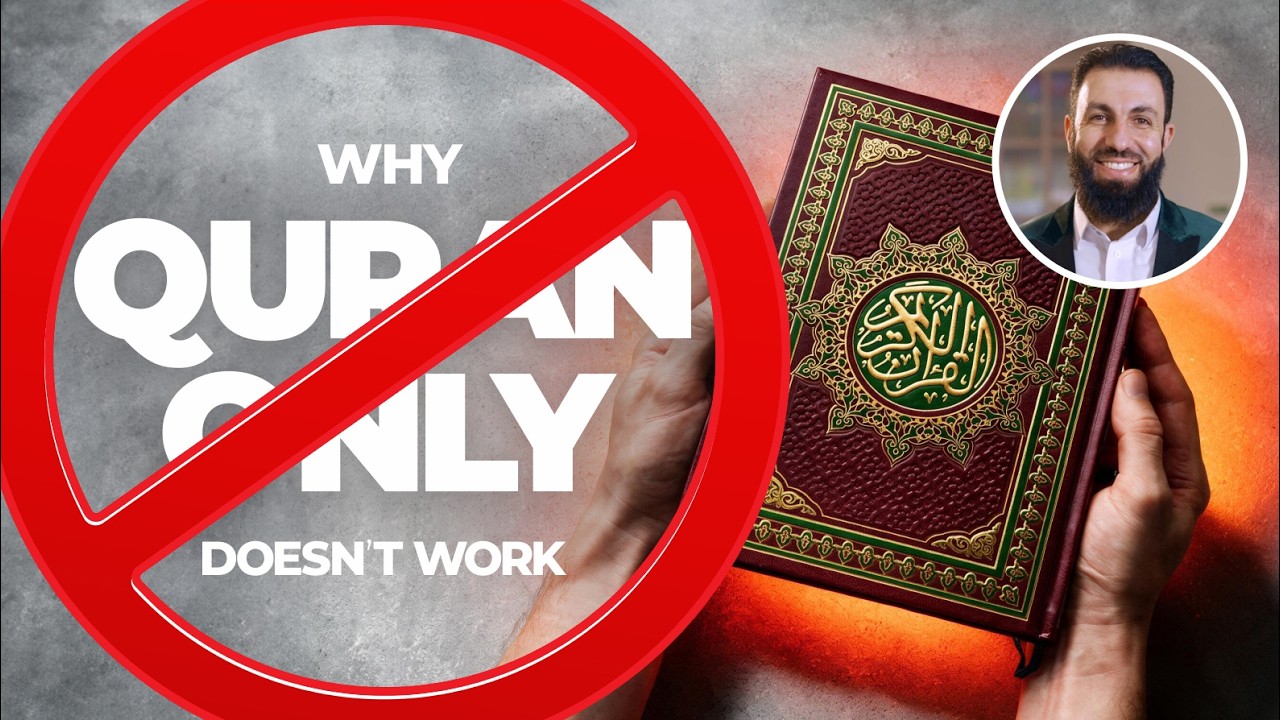
In this video, we shift from healing the heart to protecting the mind, breaking down exactly how Islam’s system of primary and secondary sources works, why the Quran and Sunnah are inseparable pillars, and why the modern “Quran-only” movement collapses under basic Islamic and linguistic scrutiny.
0:00 – Recap: Heart to Mind
2:12 – Who Are the Quranists?
3:53 – Why It Appeals to Youth
6:08 – Series Roadmap
13:06 – The Two Pillars
14:06 – Pillar One: The Quran
16:36 – Preserved vs. Transmitted
18:00 – Pillar Two: The Sunnah
19:07 – Obey the Messenger
26:49 – The Mailbox Myth
33:12 – Don’t Bypass the Prophet ﷺ
35:19 – Obey, Don’t Worship
38:41 – Defining “Hadith”
41:14 – Compiling the Quran
54:04 – Consensus & Analogy
==============================================
Support Us: https://www.belalassaad.com.au/donate
Subscribe to Email list: https://www.belalassaad.com.au/email-opt-in
Instagram: https://www.instagram.com/belal.assaad/
TikTok: https://www.tiktok.com/@belal.assaad
Facebook: https://www.facebook.com/officialbelalassaad
Podcast: https://tr.ee/QaaCJeM6qZ
source

Jazak'Allah Khairan
Thank you for another insightful lecture. Like you, I hold a strong belief in the Quran and Sunnah as our primary sources. However, your mention of secondary sources—such as Qiyas (analogical reasoning) and council-based rulings (Ijma)—is where a lot of confusion arises for me. You may be covering this in detail in upcoming lectures, but I wanted to raise the question here.
My understanding has always been that the Quran and Sunnah are complete and comprehensive for all times, covering every fundamental human question. If that is correct, why are secondary methodologies necessary for modern topics? Are scholars using Qiyas and Ijma simply as tools to extract guidance directly from the primary texts, or are they separate frameworks altogether? If they are separate, then the assertion that the Quran explicitly covers every question seems incomplete without further contextual background.
I ask this strictly out of a sincere desire to learn and understand, as I often struggle to reconcile how certain contemporary fatwas are derived today. I would greatly appreciate your guidance on this.
Where is part 1
Assalamu Alaikum Sheikh.
I sincerely appreciate and respect your efforts in teaching and guiding people in matters of Islam. May Allah reward you abundantly.
I would only like to say that when some people refer to the Qur’an alone in certain matters, it is not because they are abandoning or disrespecting the Prophet Muhammad PBUH. Rather, they are being cautious because they do not want to attribute something to the Prophet PBUH that he may not have said.
We have heard different narrations attributed to the Prophet PBUH, and we also know that Islamic scholars have sometimes differed regarding the authenticity or interpretation of certain hadiths. Therefore, some people prefer to be certain before saying, “The Prophet PBUH said…”
This is not intended as disrespect to the Sunnah or to the scholars, nor is it an attempt to undermine their position. It is simply a sincere desire to speak according to what I understand.
And the reason is that, Recently, I prepared some educational books based on the Qur’an alone, and after hearing this, I became concerned that I might have committed a major sin. However, Allah knows my intention. My intention was never to reject the Sunnah of the Messenger of Allah PBUH. Rather, I was trying to avoid attributing anything falsely to the Messenger of Allah PBUH.
May Allah guide us all to what is correct and increase us in knowledge, wisdom, and sincerity.
JazakAllahu Khairan.
These Quranist believe the prophet was just reciting Quran for 23 years and nothing else.
اَلسَلامُ عَلَيْكُم وَرَحْمَةُ اَللهِ وَبَرَكاتُهُ
And the biggest question remains: Did God authenticate Al-Bukhari's collection Hadiths?
The Sunni and Shia sects and mazhabs were interpretation corruption vehicles created by the Ummayads and Abbasid rulers.
They mistranslated most of our hadith, so the following in the sect of Islam is some truth with much falsehood and non following
They took men who were studying the religion and used their names Hanafi etc to lie about 4 imams while those were state vehicles of corruption
While doing that they hid our 12 imams from the Messenger SAWS family to prevent love and followewing of them, the guidance.
Allahumma barik ❤❤❤
I am sorry, I really realy tried, I even went as far as 40 mins in.
Your arguments are so weak and refuted on their premise by people you call قرآنيون that you are a waste of my time. I even gave you the benefit of the doubt! You are simply full of it, if you know what that means .
The Moroccan muṣḥaf also spells some words differently. For example, the qaf is written with one dot above, and the fā' is written with one dot below. But it is till Arabic, and the pronunciation is the same. Writing is a series of symbols, signifying language; it is not language itself.
I understand your point but that thumbnail isn’t acceptable! The word of Allah comes before EVERYTHING but Allah himself!
I think these new people are the new type of khawarij. Imagine decades ago, they just go for war. Now they be ridiculing everything, even the scholars
Issues answered:
1 – Those who transmitted the Quran were not the same people as those who transmitted hadith (Hafs and Asim have no hadith attributed to them).
2 – prophet Muhammad pbuh was given a sunnah called the Sunnah of Allah, which is founs numerous times in the Quran. The blessed prophet wouldn't betray Allah by changing this perfect sunnah to one attributed to himself.
3 – Obey Allah and Obey the messenger. At the time there were Jews and Christians. It you tell them "Obey Allah.." they will reply 'We already Obey God' , but now they must obey the messenher (meaning Obey what THIS messenger came with = The Quran).
4 – The Shiekh calls the Messenger pbuh an insignificant human being,indicating that we would have the heart to call rasoolAllah that. No. He was not a mailman like he says because a mailman doesnt know the package they're delivering. Ya Sheikh you were truly unfair here.
5 – chapter 16:44. The verse which is cited by top sheikhs (as in this example) to state that the messenger pbuh was told to explain the Quran and therefore a separate resource of guidance must exist. Please read the verse again and if you dont see it then read it one last time. At the time the Quran was sent down to our blessed prophet there were no Muslims, only Jews and Christians who had recieved wahi from Allah but were left with corrupted text. Muhammad pbuh was told to clarify to THEM (meaning those before him) what was revealed to THEM. The text is clear and if you listen to the sheikh again he reads it clearly but for some reason he cant see whats right in front of him.
6 – The Sheikh hasn't mentioned once that Allah has explicitly told us believers not to believe in any other HADITH after the Quran. Look at 45:6, 7:185. This is clear. This makes sense when Allah says in 2:2 "THIS IS THE BOOK.."
Lastly, if you believe the Hadith of Bukhari and those after him are indeed from the prophet pbuh abd that everything the prophet said is wahi, then by logic you have to accept the hadith as the final revelation. Why do you even need the Quran if everything is in the hadith and sunnah?
Using mundane analogies like a mobile phone for sacred texts is an insult to Allah's omnipotence and omniscient. Comparing the Quran—the uncreated word of Allah revealed in 114 Surahs, 6,236 verses, and ~77,430 words—to a mobile phone user manual creates several distinct problems:
1. The Problem of Reductionism
• The Analogy's Logic: Speakers often use the "phone manual" analogy to argue that just as a complex device (a phone) comes with a guide (a manual) and requires a representative/technician (the Prophet) to demonstrate it, humans need both text and external instruction.
• The Theological Conflict: A mobile phone is an engineered, commercial product, and a user manual is a human-written document intended solely for troubleshooting mechanics. Using this comparison risks reducing divine revelation—an eternal, sublime guidance for the soul—to a consumer product guide.
2. Contradicting Surah Al-Ma'idah (5:3)
Surah 5:3 explicitly asserts divine completion and perfection:
{الْيَوْمَ أَكْمَلْتُ لَكُمْ دِينَكُمْ وَأَتْمَمْتُ عَلَيْكُمْ نِعْمَتِي وَرَضِيتُ لَكُمُ الْإِسْلَامَ دِينًا)
"This day I have perfected for you your religion and completed My favor upon you…"
• The Quranic Position: The Quran declares itself to be fully detailed (Mufassal, 6:114), a clarification of all things (Tibyanan li-kulli shay', 16:89), and free from defect.
• The Analogy's Implication: If the Quran is framed as a manual that cannot function without secondary human compilations—much like a phone manual that leaves out critical setup steps—it inadvertently implies that the Quran itself is incomplete or insufficient on its own terms. To add anything more is bi'dah and to enforce it is shirk.
3. Categories of Speech
• Man-Made Tools: Human technology requires external updates, external technicians, and operational instruction manuals because humans create imperfect products.
• Divine Guidance: Allah’s revelation addresses the human spirit, morality, intellect, and law. Framing the Quran through mechanical analogies strips the text of its sacred nature and overlooks Allah’s promise of divine preservation (Hifz, 15:9).
While presenters use simple analogies to make complex legal arguments digestible for modern audiences, comparing the absolute word of Allah to commercial electronics and operational manuals risks trivializing the scripture and conflicting with its internal statements of perfection.
As Izutsu stated, the Quran can explain itself via semantic analysis.
What is stated in the Quran 114 Surahs, 6,236 verses, and ~77,430 words and complying what is demanded therein is sufficient to merit one for eternal life in Jannah. One do not have to drink camel urine or all sorts of non-Quran weird acts to get something extra.
Allah explicitly states that the Quran is made easy to remember/understand is repeated four times in Surah Al-Qamar (Chapter 54)—specifically in verses 17, 22, 32, and 40:
{وَلَقَدْ يَسَّرْنَا الْقُرْآنَ لِلذِّكْرِ فَهَلْ مِن مُّدَّكِرٍ}
"And We have certainly made the Qur'an easy for remembrance, so is there any who will remember?" (Surah Al-Qamar 54:17)
• Surah Maryam (19:97):
{فَإِنَّمَا يَسَّرْنَاهُ بِلِسَانِكَ لِتُبَشِّرَ بِهِ الْمُتَّقِينَ وَتُنذِرَ بِهِ قَوْمًا لُّدًّا}
"So, [O Muhammad], We have only made the Qur'an easy in your language that you may give good tidings which it to the righteous and warn which it a hostile people."
• Surah Ad-Dukhan (44:58):
{فَإِنَّمَا يَسَّرْنَاهُ بِلِسَانِكَ لَعَلَّهُمْ يَتَذَكَّرُونَ}
"And Indeed, We have made the Qur'an easy in your tongue that they might be reminded."
• Surah Az-Zumar (39:28):
{قُرْآنًا عَرَبِيًّا غَيْرَ ذِي عِوَجٍ لَّعَلَّهُمْ يَتَّقُونَ}
"[It is] an Arabic Qur'an, without any crookedness, that they might become righteous."
What the sheikh said in the beginning is true: The Quran alone movement is rapidly growing among thinking men and women who are not afraid to question what they hold as true. The people who tend see us as kafirs are usually those who have never read the Quran themselves but rely on others to think for them. Once you read the holy words of Allah SWA you will realise why those words are sufficient to guide you. Afterall His words were sufficient to create and maintain the entire universe seen and unseen, why do you think those same words aren't enough to guide you? Please dont be so quick to judge.
Why are people overcomplicating everything these days?
Pray, do good, avoid evil. Done.
You do know there's no substitute for sunnatullah
Quran only doesn't work because the Quran is full of mistakes, you need Hadiths and thousands of Tafsirs to make some sense of it. Also, the Dead Sea scrolls already proved the quran got all wrong, historically and archaeologically.
This video keeps saying the Quran needs Hadith to be understood, but never actually quotes a verse that says so. The Quran literally calls itself "fully detailed" (6:114) and "clarification for all things" (16:89). If God says His Book is complete, who are we to say it’s missing a user manual?
Also, the whole "same people transmitted both so you can't reject one" argument ignores 15:9. God promised to preserve the Reminder Himself. He never made that promise about hadith collections or compilation committees. Those are historical narratives, not Quranic doctrine.
And where does the Quran ever authorize Ijma or Qiyas as sources of law? It actually warns against following conjecture (6:148) and asks "what hadith after Allah and His verses will they believe?" (45:6). You can't build a religious framework on sources the Quran doesn't mention while claiming to follow the Quran.
Obedience to the Messenger is real (4:80), but the Quran defines his role as notification/balagh (5:99), not independent legislation. Equating obedience to him with obedience to Allah only works if he's conveying the Message, not adding to it.
Just asking: if the Quran is truly insufficient on its own, why does it keep saying otherwise?
1:02:50 is very funny. Masha Allah
اسلام عليكم ورحمة الله وبركاته.
Zayd ibn Ḥāritha al-Kalbī
(Arabic: زيد بن حارثة الكلبي) (c. 581–629 CE), was an early Muslim, Sahabi and the former adopted son of the Islamic prophet, Muhammad. He is commonly regarded as the fourth person to have accepted Islam, after Muhammad's wife Khadija, Muhammad's cousin Ali, and Muhammad's close companion Abu Bakr.[1] Zayd was a slave that Hakim ibn Hizam, Khadija's nephew, bought for her at a market in Ukaz.[2] Zayd then became her and Muhammad’s adopted son and took his lineage. His lineage was later restored just before he had his second wife Zaynab bint Jahsh divorced and married to Muhammad.[3] He later went on to marry into Muhammad's family.
Zāyd bin Thābit (Arabic: زيد بن ثابت, romanized: Zayd ibn Thābit) was the personal scribe of the Islamic prophet Muhammad, serving as the chief recorder of the Quranic text.[1] He was an ansar (helper), and later joined the ranks of the Muslim army at age 19. After Muhammad's passing in 632, he was ordered to collect the Quran into a single volume from various written and oral sources during the time of Caliph Abu Bakr. He was a noted expert on the Quran and spent much time reciting it.
Your brother in Deen s.khaan from great Afghanistan.
Laa illlaaha illlalallah may Allah for give and bless all us also those who pass Allahuakbar .
JazakAllahu khayran for covering this, Sheikh Belal. Rejecting Hadith is a very important issue, so it’s really beneficial to have a clear lecture addressing it. May Allah سبحانه وتعالى reward you and allow everyone to benefit from it. اللهم آمين
JazakAllah sheik. Really this is a big issue. A longtime friend of mine is following this movement rejecting hadiths and the more astonishing to me is that she is following a revert. May Allah give hidayah to those people.
Zaid ibn thabit was another sahaba zaid ibn haritha was the adopted son of prophet Mohammad sallalahu alaihi wa sallum, am I right, and didn’t zaid ibn haritha killed, martyred, during the life of prophet Mohammad sallahu alaihi wa sallum
I am a new revert and I have seen a lot of hadith rejectors. Thankfully I have good guides who have warned me to stay away from this.
‼️Please spread the awareness of financial rights of wife. My husband force me to work for to support home expenses. I am facing mental abuse for years even I am now doing job and supporting him financially. He gives me silent treatment for weeks and months when I request I want to quit my job because it is so stressful.
Kindly highlight this issue because always give example of Hazrat Khidaha that she was working women and wife should support husband financially.
Salaf movement soposerd by The Zionist group from USA are behind of all those things
48:11 A little correction zayd ibn thabit is not the formerly adopted son that would be zaid ibn haritha
The best way to argue with a quranist is by using their methodology.
For, instance I know based on the Quran how much I can shorten my prayer on travel, but with how many rakats can I shorten them. Does this include for all prayers?
You just ask questions using their methodology. But, say you are a revert, and you found a verse in the Quran, and wants clarification.
JazakAllahu Khairan
History is not guidance! lol.. all these positive comments , lol!! confirmation bias hahah!! why r u guys so nieve? did prophet muhammad witness the hadith being compiled and written? nooooooo can he give testimony then? absolutely NO! hence !! u cant take it as religion !! its just subjective history!!.. also DId prophet muhammad witness the quran? yes can he give testimony yes! did allah say he is a witness over it? yes!!! .. this is what submission to allah means!!.. Quran is ahsana Hadith!! what does ahsana mean? is bukhari and muslim the best? lol!! offcourse no cos they need to be graded lol!! use your brains please..
Sheikh has really explained and articulated this issue well mashallah.
A person said "(Allahuakbar)" later he said "(SubhanAllah)" after that he said "(Alhamdulillah)" he again said (Allahummagfirli) he also said (la ilaha illa anta subhanaka inni kuntu minaz zalimin) in that he earned many many good deeds and that person is you ♥️
Such a meticulous conversation. When truth is separated from false so clearly, in Urdu we say 'doodh Ka doodh, paani Ka paani'. Can't wait for the next lecture insha'Allah.
Categorised verses with analogies scaffolded the core and made it much more coherent and easier to understand. As a non Arabic speaker,the grammatical explanation of An Nisa verse 59 was particularly interesting. In another 'Quran only' refutation lecture, it cased a similar explanation, in Arabic speech if two similar things are mentioned separately, they can be synonymous, but if they are mentioned together, they are separate from each other. This rule was in reference to verse 113 of An Nisa 'Allah has revealed to you the Book and wisdom and taught you what you never knew' The Book is the Quran and wisdom (Hikmah) is the Sunnah and Hadith of the Prophet SAW.
There can never be 💯 equivalence between two languages as there are language, cultural and situational nuances and tones and emotions that are lost in translation.Saying that one is capable of deriving their own interpretation from the translation of a text that is not even in the language they speak, and/or dismissing the Hadith and Sunnah and challenging the work of scholars, is a flippant and self destructive claim. Not to mention the numerous practical dysfunctionalities of Hadith rejection. Unless as you say Sheikh, "its a way to get away with anything" by making up meanings that suit the whims. And that emoji in the title, we hear you Sheikh. May Allah bless this channel to reach and guide more hearts to the truth. Ameen
I think even more concerning are those who put the Hadiths first and the Quran second or even not at all. Boots on the ground, I've run into more of those types of Muslim rather than the Quran only types. That's an important topic that needs to be addressed as well.
1:09:00 looking forward to next video regarding the system. Also, could you talk a little about why Shia Hadiths aren't trustworthy while they take sunni hadith as trustworthy even though not all of them necessarily. as far as I have understood they(Shia) use logic. e.g. they trace back to a source of the hadith and see if the teller is pro muawiyah against Ali etc. @belalassaad
A few days ago I seen a persons film this live 🫶
As-salamu alaykum Sheikh there is something I need to have knowledge of and I would like to hear it from a Sheikh Scholar like you are. Is there a way to privately message you and I dont have social media. jazakallahu khairan
May the Hadith always be done. You are not black and yes, I pray u don’t leave me.